
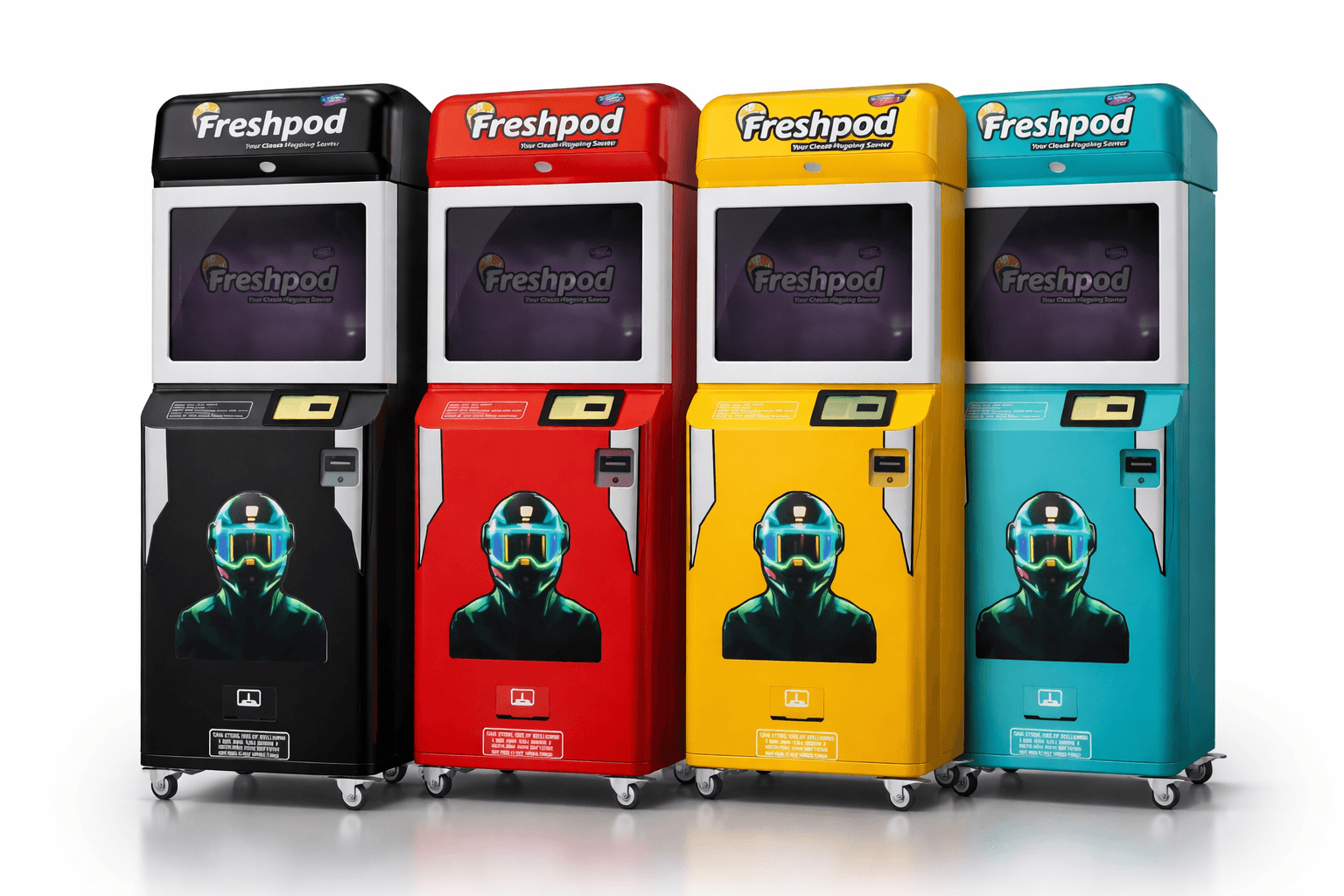
Freshpod Helmet Sanitization Machine
Modernized and redesigned FreshPod's automated helmet sanitization machine from the ground up — reverse-engineering the complete physical assembly in Autodesk Fusion 360 (80+ parts), recreating the master control PCB to eliminate legacy freeze states, rewriting firmware for dynamic Razorpay UPI QR codes, redesigning DGUS HMI tools, and deploying OTA updates with real-time heartbeat telemetry across 200+ machines in 3 countries.
What Makes This System Unique
Complete 3D CAD redesign in Autodesk Fusion 360 (80+ unique mechanical components, stainless-steel CNC enclosure)
Re-engineered custom ESP32 master control PCB from scratch across 5+ revisions, resolving legacy hardware lock-ups
Redesigned DWIN DGUS display tooling and binary UART protocol to render dynamic Razorpay UPI QR codes natively
Over-The-Air (OTA) firmware pipeline with dual-partition flash recovery and live machine heartbeat diagnostics
Field-tested aerodynamic ventilation loop and micro-perforated mesh exhaust for deep interior helmet treatment
Long-term engineering partnership with up to 10-year support agreement covering mechanical, PCB, and firmware revisions
Overview & Modernization Genesis
FreshPod India had developed an early-generation physical machine for automated helmet sanitization, but was facing severe scaling and field reliability bottlenecks: their legacy control PCB frequently locked up under relay switching loads, the mechanical structure lacked standardized production CAD documentation, the display could not process dynamic payment QR codes, and operators had zero remote observability or OTA update capabilities. Freshpod partnered with SolveMpire to execute a complete end-to-end modernization. Our team reverse-engineered and redesigned the entire physical machine in Autodesk Fusion 360, recreated the master electronics PCB from scratch, rebuilt the embedded firmware and DGUS HMI tools for dynamic Razorpay UPI integration, and established a cloud-connected fleet management platform with real-time heartbeats and OTA updates. The modernized machine scaled from prototype remediation to a robust commercial fleet of 200+ deployed units across India, Nepal, and Sri Lanka.
From Payment to Sanitized Helmet Workflow
The machine was designed around a frictionless 5-minute operational workflow: 1. Customer initiates the service via the touchscreen interface. 2. Customer completes payment through the integrated Razorpay UPI/QR workflow. 3. The machine authorizes the transaction and automatically releases the magnetic door. 4. The operator places the helmet inside the sanitization chamber and secures the door. 5. The automated sanitization sequence executes (UV treatment → fogging treatment → final UV treatment). 6. Upon cycle completion, the door releases, and the operator removes and dries the helmet. The chamber was engineered to accommodate a broad spectrum of commercial helmet geometries rather than requiring a helmet-specific fixture.
Complete Mechanical Product Development (80+ Components)
Our mechanical engineering team was responsible for the machine's complete structural architecture. The production design contains 80+ unique mechanical components, including: • Main stainless-steel enclosure (roughly 5 ft high × 2 ft wide × 2 ft deep, 50–75 kg) • Internal sanitization chamber & equipment isolation chambers • Precision door assemblies & magnetic locking arrangement • Helmet positioning structure & UV/fogging module mounts • Internal ventilation routing, fan mounts, and airflow management • Cable routing channels, access/service panels, viewing windows, and casters The production enclosure is manufactured from stainless steel using CNC bending and sheet-metal fabrication processes.
Sanitization Chamber & Thermal Engineering
One of the major engineering hurdles was ensuring that the sanitization medium reached the deep interior of different helmet shapes, rather than merely washing over exterior surfaces. The helmet is positioned with its head opening oriented directly toward the treatment airflow. We designed a dedicated fan-assisted ventilation loop, incorporating a precision mesh-based airflow outlet at the end of the flow path to improve distribution and achieve a uniform treatment vortex around the helmet. Because the UV lamps and fogging generators produce concentrated heat inside the cabinet, our team conducted extensive thermal testing, ventilation optimization, and mechanical revisions to keep temperatures strictly within safe operating bounds without active refrigeration shortcuts.
Custom Electronics & ESP32 Machine Control PCB
Rather than using disconnected third-party controller boards, our team developed a unified custom control PCB built around an ESP32 microcontroller with a 12 V power architecture. The PCB handles: • Magnetic door locking & state monitoring • UV lamp & fogging system relay control • Fan speed control & current sensing • Touchscreen communication over UART • Machine-state management & fail-safe interlocks • Wireless connectivity & OTA firmware updates The PCB underwent 5+ hardware revisions before reaching its final production-grade reliability.
Embedded Firmware & State Control Architecture
The machine firmware was developed in C++/Arduino for the ESP32. The firmware manages deterministic state transitions across the entire physical workflow: Payment confirmation → authorization → door release → timer management → sanitization sequencing → fault detection → completion notification. Defined fault states were implemented for payment timeouts, UV/fogging/fan malfunctions, and connectivity loss, ensuring the machine enters a safe state and reports diagnostics back to the central server.
Razorpay Payment & DWIN Touchscreen HMI Integration
The machine features an 8-inch 800 × 480 touchscreen running a custom HMI developed on DWIN's DGUS platform. Because DGUS does not provide a web browser environment with HTML/JavaScript, our team built a custom UART communication protocol between the ESP32 and display. Dynamic UPI payment sessions generated by the backend are transmitted over UART to the DGUS display, allowing customers to scan a live dynamic QR code. Once payment is verified, the ESP32 automatically drives the screen transitions and physical door locks in perfect synchronization.
Remote Monitoring & OTA Infrastructure
We built a centralized cloud platform that allows operators to monitor deployed machines remotely. The system provides real-time machine heartbeats, online/offline status, revenue telemetry, error logging, and over-the-air (OTA) firmware deployments. This infrastructure allows the engineering team to deploy software enhancements and firmware patches remotely across the entire fleet without requiring on-site service visits.
Prototype to Commercial Production in Andhra Pradesh
Development spanned 2 major physical prototypes, 10+ mechanical revisions, and 5+ PCB revisions. Prototype testing identified and solved critical airflow, fan performance, heat dissipation, and mechanical packaging constraints. The finalized machine moved into commercial volume manufacturing in Andhra Pradesh, India, with our team supplying complete production CAD packages, 2D drawings, BOMs, and manufacturing support.
Continuous Field Engineering & 10-Year Support Agreement
With 200+ machines operating across India, Nepal, and Sri Lanka processing over 200,000 helmets, field data informed continuous hardware and software refinements. Our partnership with Freshpod is backed by an engineering support agreement extending up to 10 years, covering ongoing mechanical improvements, firmware updates, PCB revisions, and technical support.
Validated Performance In The Real World
- 200+ machines commercially deployed across India, Nepal, and Sri Lanka
- 200,000+ helmets reportedly processed (~30–40 helmets daily capacity per machine)
- 80+ unique mechanical components, 10+ mechanical revisions, and 5+ PCB hardware iterations
- End-to-end integration: Mechanical CAD + Custom PCB + ESP32 Firmware + DGUS HMI + Cloud OTA
- Long-term partnership with up to 10-year engineering support agreement