
Egg Vending Machine (AEEGZ) — Modular Architecture & Dual 4-Layer KiCad PCBs
Designed a modular, tray-agnostic egg vending architecture for high-density egg storage (~702 eggs across 42 variable-pitch compartments), powered by a dual 4-layer KiCad PCB architecture: a Main Controller running a Toradex Verdin i.MX 8M Plus Linux SoM and STM32F407 MCU, and modular 20-channel CAN Door Controllers for infinite daisy-chainable scaling.
What Makes This System Unique
Variable-pitch compartment architecture: 12 six-egg, 15 twelve-egg, and 15 thirty-egg doors (~702 egg capacity)
Dual 4-layer PCB architecture: Master board (i.MX 8M Plus Linux SoM + STM32F407) and modular CAN Door Controllers
Daisy-chainable CAN expansion: 20-door module banks plug into CAN bus without central MCU rewiring
Eliminated motorized egg-by-egg dispensing, preventing egg collision, double drops, and drop jams
Full hardware protection: TI LM76003 3.5A synchronous buck, LMR33630 regulators, SS14 flyback diodes, and NUP2105L CAN ESD protection
Phased roadmap: Phase 1 (passive ventilation & thermal mapping) → Phase 2 (active AC) → Phase 3 (modular boiler)
Overview: Re-Thinking Automated Egg Vending
Dadspire Solutions approached us with reference designs based on existing Chinese egg vending machines. The objective was not merely to copy those machines, but to maximize usable storage in a compact footprint while supporting multiple commercial egg-tray formats. The business model added a critical constraint: 6-egg trays attract new customers, while 12- and 30-egg trays carry higher commercial margins. The cabinet layout needed to accommodate all three formats strategically rather than wasting premium volume on a uniform grid.
Local Market Tray Research Drove Mechanical Architecture
Instead of assuming arbitrary compartment dimensions, our team surveyed approximately 20 egg-tray brands available locally around the client's site and hatchery. We evaluated tray length, width, height (common height ~133.5 mm), geometry, and practical usability. The core design decision was to build the machine around commercially available trays rather than a proprietary dispensing mechanism — so the machine is not sensitive to slight variations in egg size or shape, and the operator is not locked into a single tray supplier.
Variable-Pitch Compartment Architecture (~702 Eggs)
Instead of 42 identical boxes, compartment dimensions vary by tray format: • 12 compartments for 6-egg trays • 15 compartments for 12-egg trays • 15 compartments for 30-egg trays Total Phase 1 capacity: (12 × 6) + (15 × 12) + (15 × 30) = 702 eggs within an overall envelope of 1,828 mm high × 1,060 mm wide × 406 mm deep (75–125 kg, CNC-bent stainless steel).
Eliminating Dispensing Mechanisms by Design
There is no motorized egg-by-egg dispensing mechanism. The workflow is: Customer selects tray → payment confirmed → corresponding compartment unlocks → customer opens door and removes tray → door closes. This decision eliminated an entire category of failure modes (individual egg handling, egg-by-egg actuation, double dispensing, egg collisions, and motorized mechanism jams), shifting the engineering focus to high-density, secure storage.
Master Control PCB: Toradex Verdin i.MX 8M Plus + STM32F407
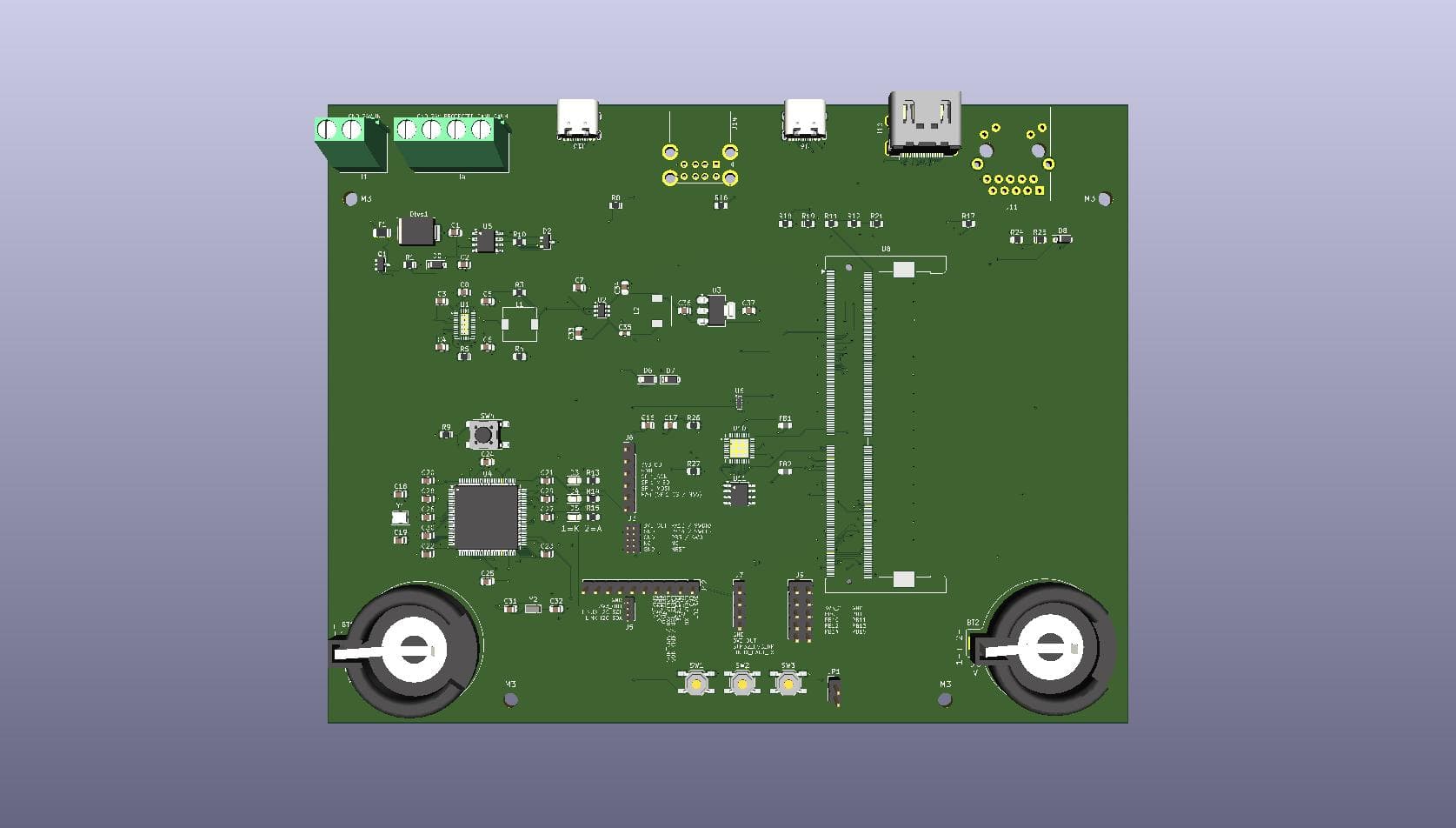
The central intelligence runs on a custom 4-layer KiCad master control board designed around a heterogeneous computing architecture: • Linux Application Layer: Toradex Verdin i.MX 8M Plus System-on-Module (SoM) seated in a 260-pin DDR4 SODIMM socket, running high-level touchscreen UI, payment gateway sessions, camera vision, and MQTT cloud telemetry. • Real-Time Control Layer: STM32F407VET6 (168 MHz ARM Cortex-M4F) executing deterministic state machines, safety interlocks, and sensor polling. • Industrial Power Architecture: 24 V DC input with P-channel MOSFET reverse-polarity protection, TI LM76003 (3.5 A synchronous buck) stepping down 24 V to 5 V, AP63203 (2 A buck) generating 3.3 V, and low-noise AMS1117 LDO. • Peripheral Hub: USB2512B 2-port Hi-Speed USB hub, AP2192 current-limited power switches, TPD4EUSB30 ESD arrays, dual CR2032 RTC battery backups, and SN65HVD230 CAN transceiver with NUP2105L TVS protection.
Modular CAN Door Controller: Daisy-Chainable 20-Door Subsystem
Rather than running 100+ wires back to the central controller, we engineered a dedicated 4-layer Door Controller board that acts as an independent CAN bus node: • 20 High-Current Solenoid Channels: High-side/low-side MOSFET drivers switching 9 V–12 V pulses to solenoid locks, protected by 20× SS14 Schottky flyback diodes. • 20 Sensor Feedback Channels: Optocoupled door microswitch inputs with RC low-pass debouncing and 20× onboard 0603 SMD indicator LEDs for instant visual diagnostics. • Scalable Daisy-Chaining: Features CAN Input (J6) and CAN Output (J49) terminal blocks with 5 A PTC input fusing and dual LMR33630 buck regulators. Expanding the machine from 42 doors to 100+ doors requires simply linking an additional door PCB over a 3-wire CAN bus without changing main MCU firmware.
Environmental Monitoring & 3-Point Thermal Mapping
Phase 1 incorporates passive ventilation via three fans and three temperature sensors positioned at the top, middle, and bottom of the cabinet. Rather than a single temperature reading, this builds a thermal map of the cabinet to generate empirical data for Phase 2 active AC cooling integration.
Phased Thermal & Cooking Expansion Roadmap
The machine architecture is explicitly phased: • Phase 1: Passive ventilation + 3-point thermal monitoring (current) • Phase 2: Active AC cooling (cabinet engineered to extend in height) • Phase 3: Separate adjacent boiler/cooking module (isolated for steam, water, and electrical safety)
Manufacturing Engineering: Stainless Steel CNC Bending
Complete production documentation was delivered in Autodesk Fusion 360 and KiCad, including 3D CAD, 2D manufacturing drawings, DXF files, bend drawings, BOMs, Gerber packages, and assembly documentation across 6 major CAD revisions. Phase 1 prototype fabrication is currently in progress.
Validated Performance In The Real World
- Tray-agnostic storage architecture accommodating 6-, 12-, and 30-egg commercial formats
- ~702-egg Phase 1 capacity designed to scale to ~1,500 eggs via plug-and-play CAN door modules
- Dual 4-layer KiCad PCBs separating Linux application logic from real-time safety and daisy-chainable door driving
- Eliminated motorized dispensing drop failures through secure compartment unlocking
- Complete production Gerber packages, DFM-verified BOMs, and fabrication documentation delivered